Built by people who actually patch.
ModulRift came out of a habit: at 1am you make a patch that breathes, you record 90 seconds to your phone, and three weeks later you’re staring at a wall of jacks trying to reverse-engineer your own sound. The notebook-on-the-desk version works — until it doesn’t.
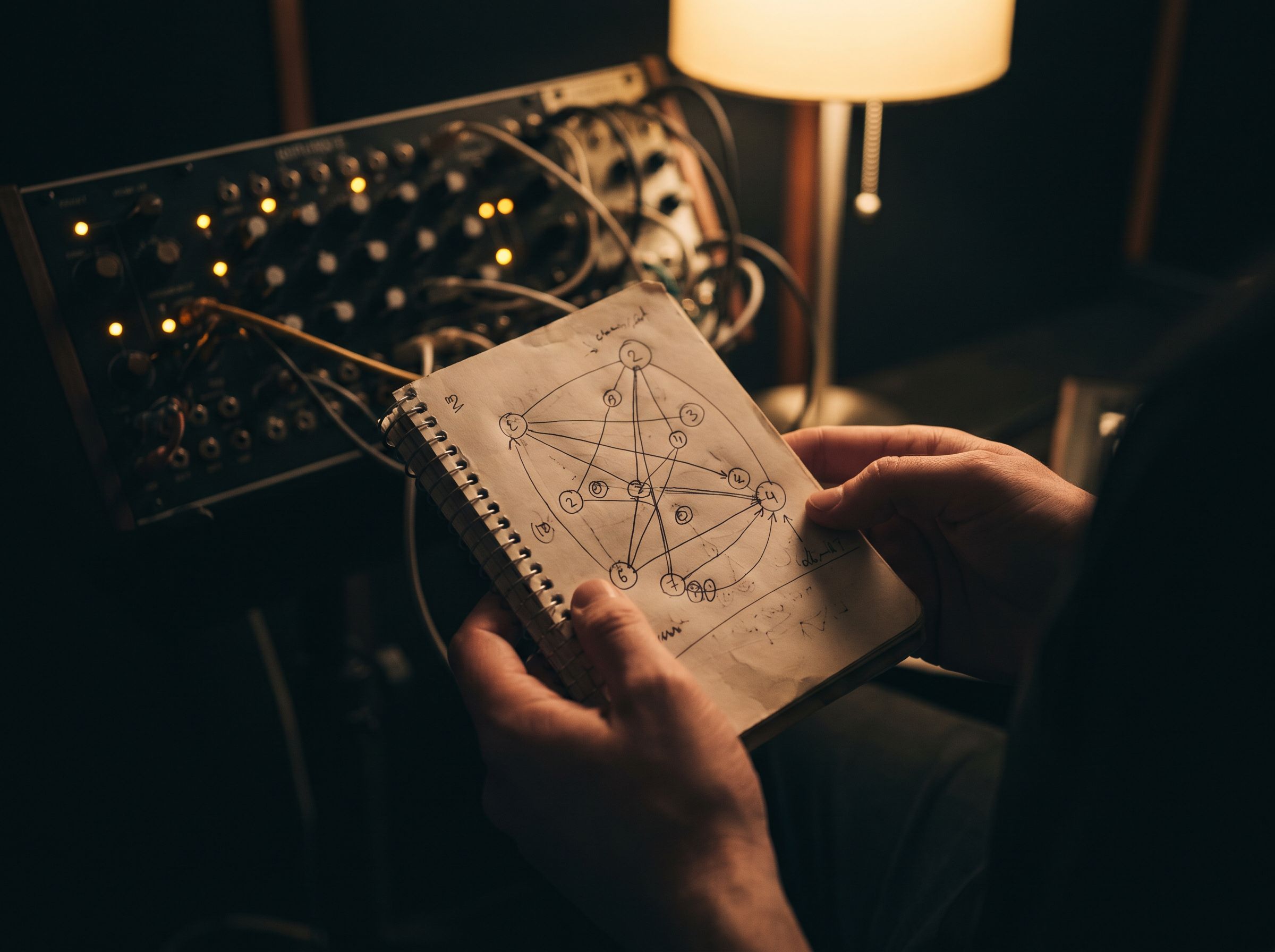
Hardware modular, not soft.
Most “patch managers” are built for VST presets. ModulRift is built for cables. It models your actual rack — Maths, Plaits, Mimeophon, the lot — and writes patches against what you really have. No suggestion will ever ask for a Buchla 281 you don’t own.
The journal half is yours forever, on the free tier. The AI half is metered — pay for what you render, never a subscription, never a “seat.”
Restraint over costume.
No fake knobs, no skeuomorphic LEDs. We reference panel typography; we don’t cosplay as a Mother-32.
Numbers in mono.
BPM, HP, credits, knob positions. All in Geist Mono with tabular nums. They line up like a VU meter.
One accent, one CTA.
Amber, used like a single lit LED. One pill button per screen, where it matters.
No subscriptions.
Patches don’t happen on a schedule. Pay-as-you-go credits, never expire.
AI as helper, not author.
The coach gives you a starting point. You patch. That’s how it should be.
Built in the studio.
Every screen has been tested with rack in the room, not in a coworking space at 11am.